Final test phase · launch shortly
Floating equipment · ES-TRIN
Stability of your pontoon with a crane or excavator (floating equipment), calculated.
Lay out the modular pontoons, put the hydraulic excavator on the deck and fill in the work cycle. StabCal™ checks every scenario against the criteria from ES-TRIN 2025/1 chapter 22 that StabCal can calculate, works out the stability curve (GZ curve), shows the result live on the drawing and turns it into a report. A pontoon with a crane or hydraulic excavator is, as a rule, floating equipment (ES-TRIN Art. 1.01 item 1.22). National requirements of the country or of the competent authority may be stricter. Drawing and calculating in the app is free; you see the results as a draft. You only pay for the report (PDF with report number, for business use). Create an account and calculate your first assembly.
Lay out the modular pontoons, put the hydraulic excavator on the deck and fill in the work cycle. StabCal™ checks every scenario against the criteria from ES-TRIN 2025/1 chapter 22 that StabCal can calculate, works out the stability curve (GZ curve), shows the result live on the drawing and turns it into a report. A pontoon with a crane or hydraulic excavator is, as a rule, floating equipment (ES-TRIN Art. 1.01 item 1.22). National requirements of the country or of the competent authority may be stricter. We are in the final test phase. Join the waiting list: you will be the first to hear and your first report is free (per company, conditions).
We only use your e-mail address for messages about StabCal: the confirmation, the invitation and the launch.
You buy a report per project, with a report pack or with a subscription; see Pricing for what it costs.
›See how it works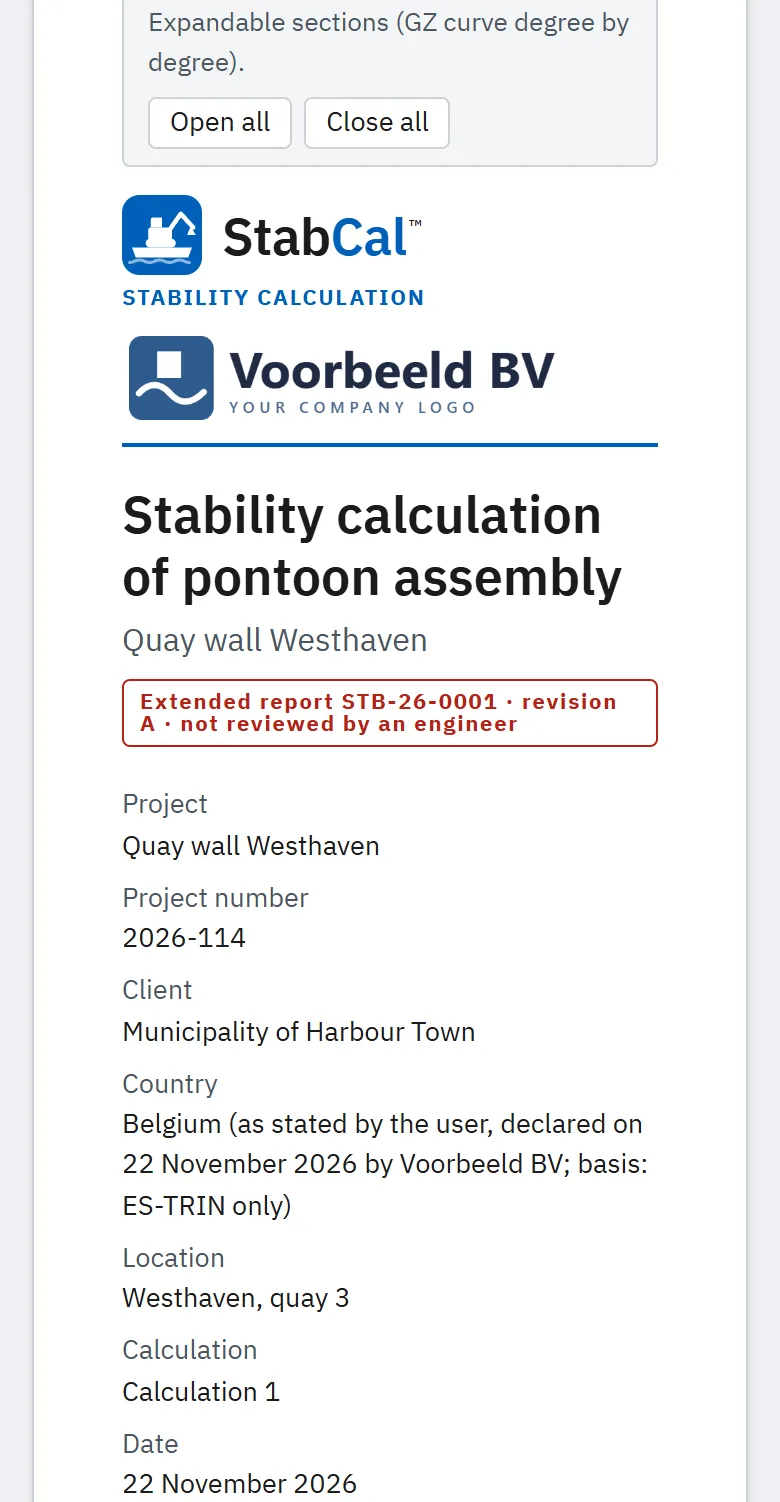
What it does
One drawing, all scenarios
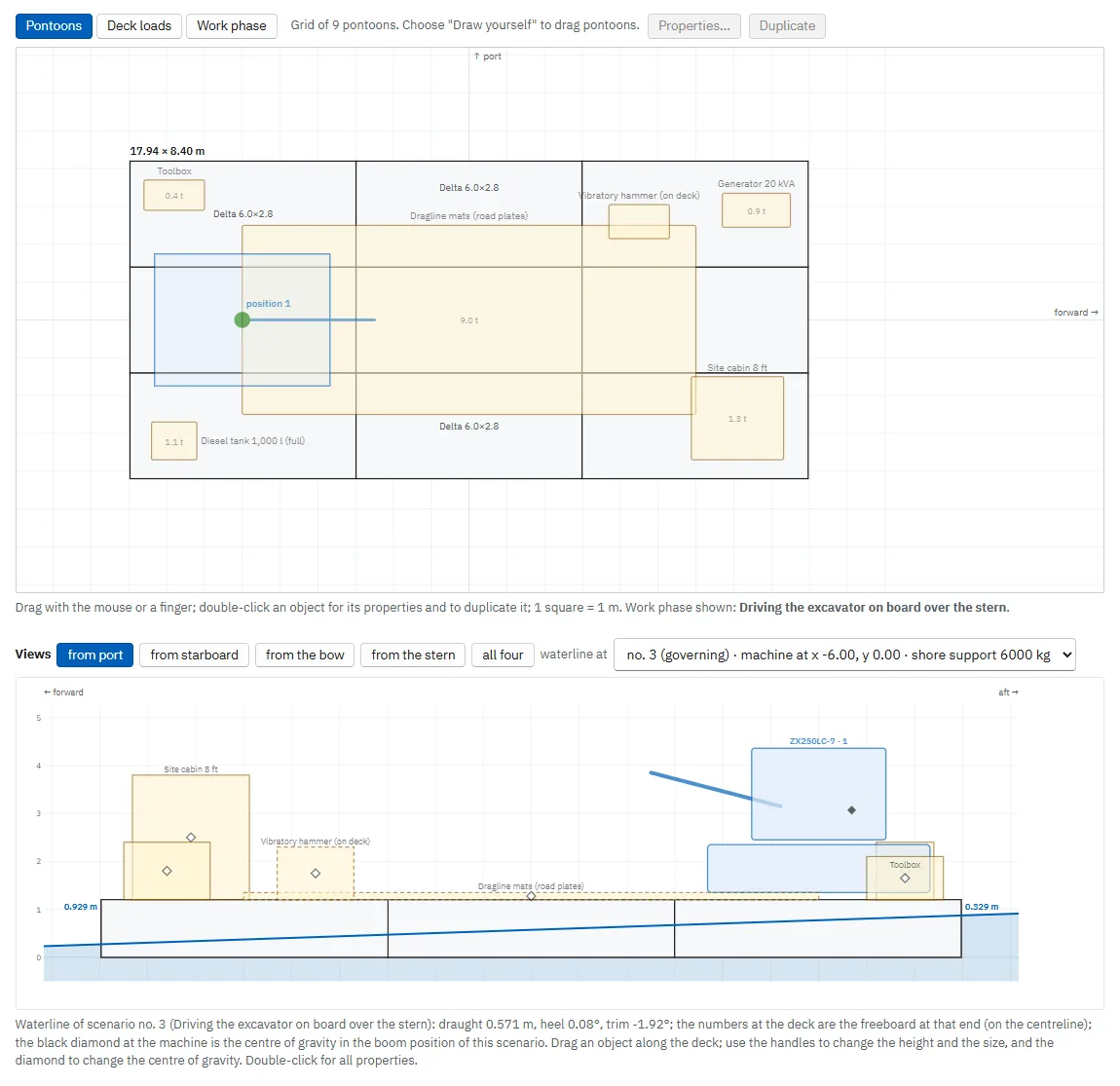
How much freeboard is left when the hydraulic excavator works at the rear on the crane mats (bog mats) with a sheet pile over the port side? How far may it drive on board before the access ramp falls away? You used to do that calculation in a spreadsheet per situation. StabCal calculates the stability of the whole pontoon assembly for all situations at once, anew with every change.
Draw the assembly
Choose modular pontoons from the library (NATO, Uniflote, Delta pontoons, container pontoons) and drag them into place; they snap together. Grid or free form, lengthwise and crosswise.
Machine with lifting capacity table
Choose the hydraulic excavator and the configuration. The centre of gravity follows from the lifting capacity table using the tipping-load principle of ISO 10567 (moment equilibrium about the tipping line); entering your own is also possible.
Deck loads and stock
Crane mats, site cabin, tanks and sheet piles: drag, scale, rotate and duplicate. With height, so that the centre of gravity and wind area come out right by themselves.
Work cycle
Per phase the positions, slewing directions, loads and stock variants. StabCal builds all combinations, identifies the governing scenario and shows the result live on the drawing.
Checked against criteria from ES-TRIN
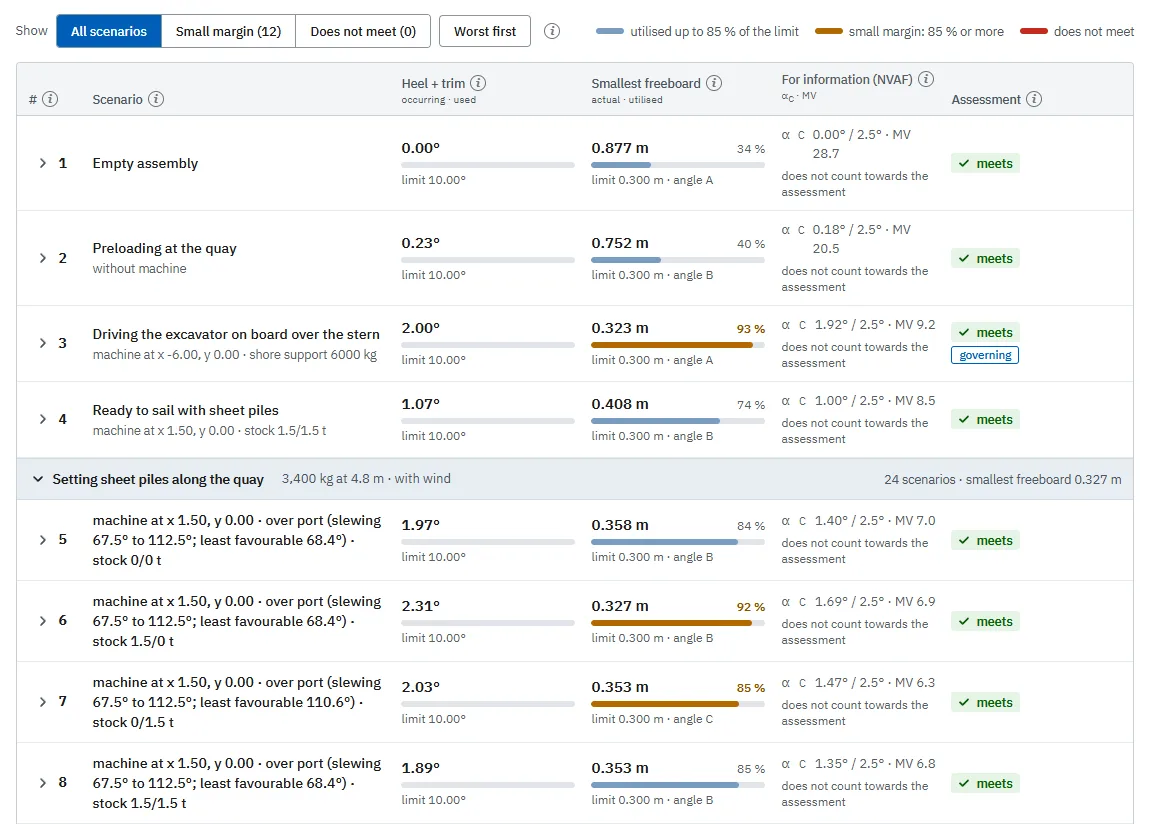
Heel and trim (sum against 10°), freeboard at every corner, wind and the stability curve, plus supplementary StabCal checks: deck-edge angle, maximum draught over cables and pipes and the sudden release of a load.
Report with your logo
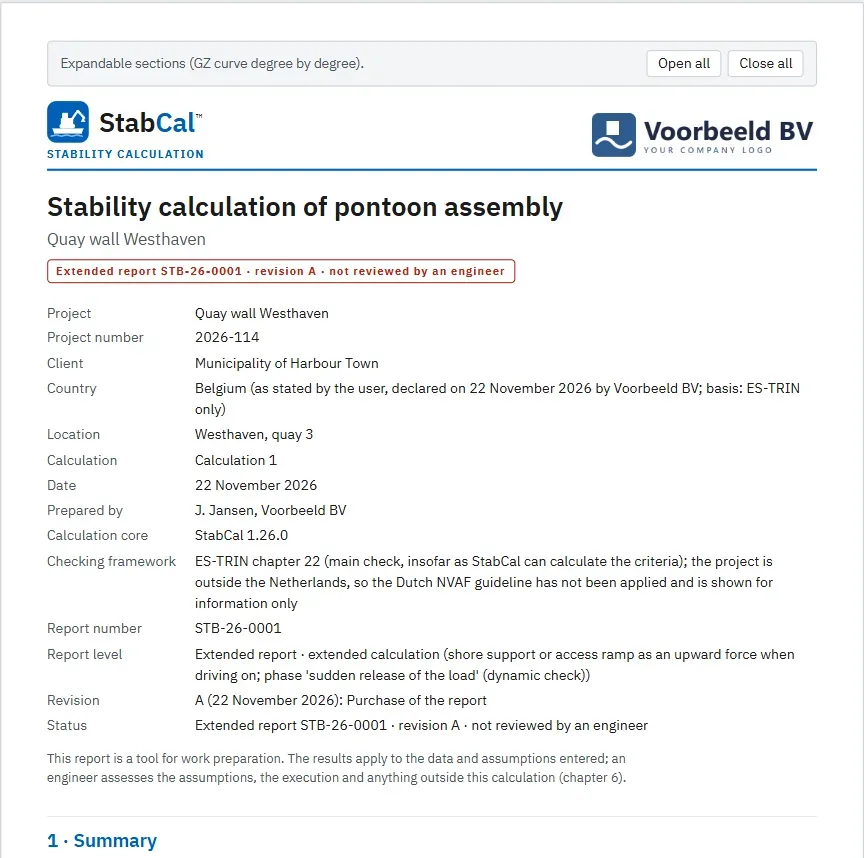
Starting points, results per scenario with views and what lies outside the calculation. The report with derivation gives per scenario the input, assumptions, weights, intermediate results and the check with its source, the GZ figures and the sensitivity analysis of your assumptions. As PDF, with your company logo.
Floating equipment
What is floating equipment?
ES-TRIN (Article 1.01, item 1.22) defines floating equipment as a floating installation carrying working gear such as cranes, dredging equipment, pile drivers or elevators. A pontoon with a crane or hydraulic excavator is, as a rule, floating equipment and falls under Directive (EU) 2016/1629. Chapter 22 of ES-TRIN contains the special provisions for floating equipment, including the proof of stability (Article 22.07). Whether your assembly is treated that way and which requirements apply is decided by the inspection body or the competent authority; national requirements may be stricter. Information with sources, not legal advice.
Read more: stability requirements for floating equipment under ES-TRIN and inspection of floating equipment.
Stability curve
Stability curve (GZ curve) of your pontoon with a crane
The metacentric height (GM) only says something about the start of the inclination. With a hydraulic excavator on the deck (floating equipment) the deck edge can be in the water at a few degrees already; the stability curve shows what happens then. ES-TRIN requires that curve, among other cases, for reduced residual freeboard (Article 22.08): the range of stability, the righting lever and the residual righting lever. StabCal calculates the curve per scenario, with free trim, fully three-dimensional and, as a check alongside it, with the envelope of three cross-sections, and checks each angle against the less favourable of the two. StabCal does not give an approval, a declaration of conformity with ES-TRIN or a proof of stability within the meaning of Article 22.07 paragraph 2; whether an assembly is accepted is decided by an expert or the competent authority.
- Range of stability, maximum lever and residual righting lever per scenario, as a figure in the report; the governing scenario can be recalculated degree by degree.
- Heel and trim added against the 10° of ES-TRIN 22.07.
- Wind, hoisted load and release included per scenario, per wind direction and slewing direction.
Read more: the stability curve of a pontoon, heel and trim under ES-TRIN 22.07 and why an inspection looks to ES-TRIN.
Reduced residual freeboard
Reduced residual freeboard under ES-TRIN 22.08: fewer pontoons needed?
An assembly with a lot of freeboard needs a lot of pontoons. If a reduced residual freeboard under ES-TRIN 22.08 can be demonstrated, an assembly can sometimes do with fewer pontoons. StabCal checks the criteria of 22.08 per scenario and shows whether your assembly meets the criteria StabCal checks. Whether that is accepted in your situation is decided by an expert or the competent authority; StabCal gives no approval and no declaration of conformity with ES-TRIN.
- Metacentric height, GZ curve with range of stability and residual righting lever, per scenario.
- Heel and trim and the safety clearance to the openings you specify on the drawing area.
- GZ degree by degree of the governing scenario in the report with derivation, so an engineer can recalculate it.
- An indication even without purchase: in the draft you see for free whether the assembly meets the criteria StabCal checks (for your own work preparation only; see the conditions article 15).
Read more in reduced residual freeboard under ES-TRIN 22.08. See the products
How it works
Draw, calculate, print
Draw
Pontoons, machine, deck loads and stock in the top view. Slew-ring positions per phase of the work. Ctrl+Z undoes any step.
Calculate
Draught, metacentric height, heel, trim and freeboard at every corner, with wind and the dynamics of a load that suddenly releases. Scenarios with a tight margin are marked separately.
The report as PDF, with the drawings and, depending on the product, the intermediate results, the checks and the sensitivity analysis of your assumptions. An engineer sees at a glance what to assess.
Engineer review
Have your calculation checked, without e-mail ping-pong
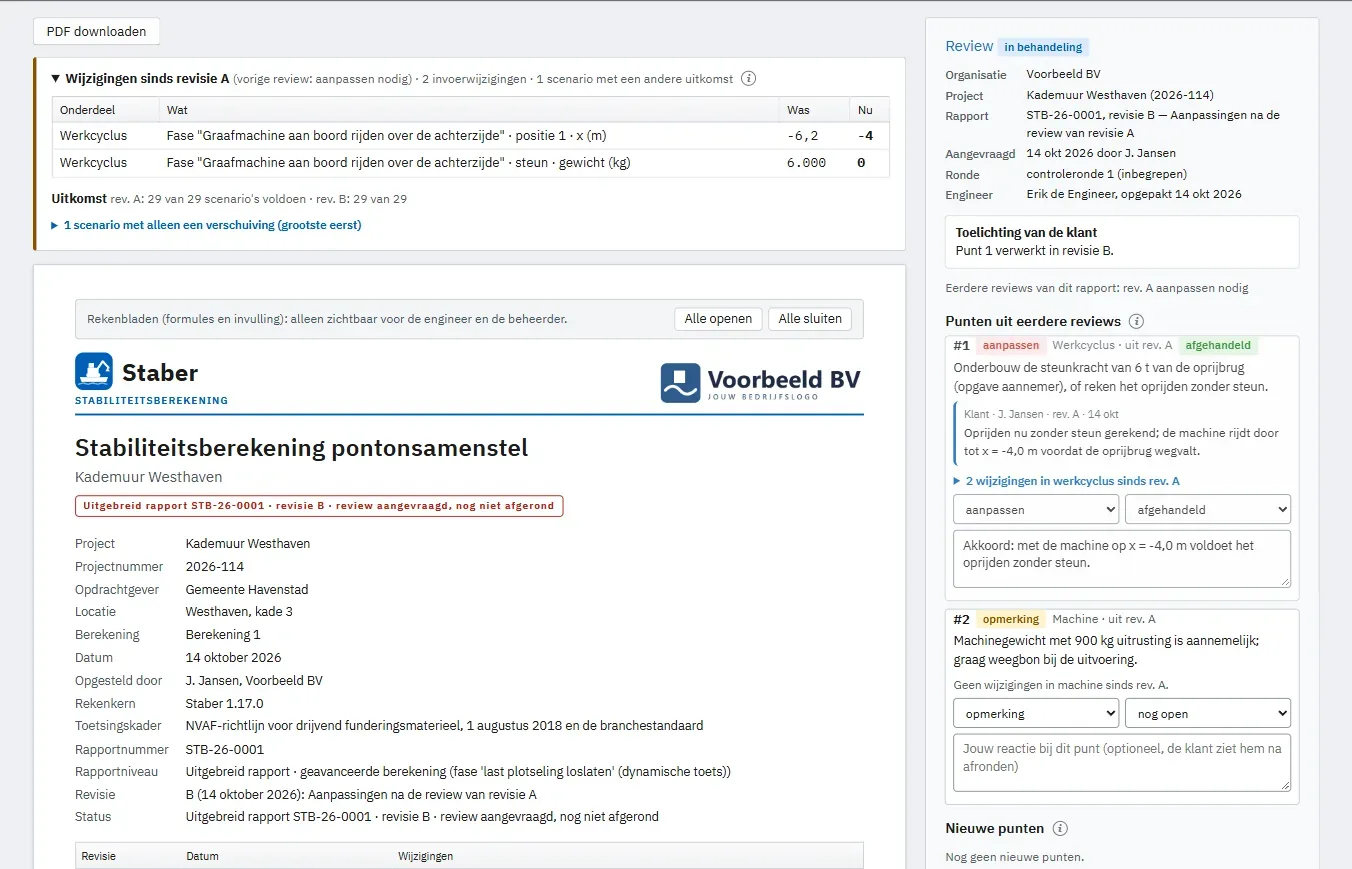
- Offer it from the report. The engineer sees the full report and the full calculation.
- Review points per part. The outcome follows from the points: agreed, agreed with remarks or adjustment needed.
- Reply per point. You explain per point how you dealt with it; everything is kept.
- Revisions by themselves. If you change the calculation after a review, it automatically becomes a new revision. The engineer sees exactly what changed in the input and in the result.
- Review rounds and price as quoted. We agree the number of review rounds and the price with you in advance.
- What the outcome means. The engineer's outcome concerns the calculation in StabCal; it is not an inspection and not an approval by an inspection body.
Equipment
Library of pontoons and machines
- Modular pontoons NATO (middle and bow pontoon), Uniflote, Delta pontoons 600×280 and container pontoons, with source and weight.
- Hydraulic excavators 38 models from Hitachi, Caterpillar, Komatsu and Volvo, on tracks and on wheels: lifting capacity tables per boom, arm, counterweight and undercarriage, over the front and over the side.
- Your own equipment you add to your company's library yourself, in the order you want.
The figures come from the manufacturers' brochures and are not adopted as one fixed value: you choose the configuration for which the table applies.
Brand and type names of machines and pontoons are the property of their owners. BASSLO is neither affiliated with nor endorsed by these manufacturers or suppliers.
Every time we put a crane on a pontoon, the calculation had to go out again. Now I draw the assembly, fill in the work cycle and have the report straight away. The engineer assesses the assumptions instead of the calculation work.
Bas van Slot, BASSLO · MRS Waterbouw · maker of StabCal
Waiting list
Be among the first
StabCal is in its final test phase. Launch follows shortly. Join the waiting list now and your first basic report is free. We already let the first users try it; we decide whom we invite and when.
- You will be the first to hear when StabCal opens.
- Be quick: the waiting list closes as soon as StabCal goes live.
- Your first basic report is free (one per company, conditions).
- You sign up without payment details, and unsubscribe with one click.
Waiting list
Pricing
Choose the report you need
Drawing and calculating in the app is free. For the report you pay StabCal is in its final test phase. Join the waiting list and your first basic report is free (one per company, conditions). We announce the rates at launch. After that you pay per report, with a report pack, or with a subscription for the whole company. A report belongs to one project, one assembly and one machine; revisions within that project are included. Which product you need follows from your calculation: the basic report, with derivation, extended or with reduced residual freeboard. Upgrading afterwards is possible; you then pay only the difference. Prices exclude VAT.
Basic report
price on request
- Situation, result per phase and scenario, assumptions and limits
- One project, one assembly, one machine
- Revisions within the project included
Report with derivation
price on request
- Per scenario the input, assumptions, weights, intermediate results and the check with its source
- The GZ figures and the sensitivity analysis of your assumptions
- Can also be added afterwards
Extended report
price on request
- With derivation
- Sudden release of the load, pressing in, freely drawn or own assembly, shore support
- Also more than three positions per phase
Reduced residual freeboard (ES-TRIN 22.08)
price on request
- With derivation, plus the check for reduced residual freeboard
- Criteria of ES-TRIN 22.08, GZ degree by degree in the report
- Sometimes fewer pontoons needed
- Together with extended: price on request
Report packs
5 or 10 reports, per product
- For the basic report, with derivation, extended or reduced residual freeboard
- With discount (5 % for 5 reports, 10 % for 10 reports), does not expire
- A credit for a higher-value product can be used for a simpler product
Basic subscription
price on request
- 20 basic reports per year, 3 users
- Your own equipment library
Unlimited subscription
price on request
- Unlimited basic reports, with derivation and extended; 10 users
- Your own equipment library
Engineer review: assessment of a report by an engineer, on request. You distribute credits and balance among your colleagues within your company.
Custom solutions
Need something StabCal does not do as standard?
Your own pontoons or machines in the library, a calculation we carry out for you, a check of an existing calculation, a link with your own systems or deviating agreements for your company. Tell us what you need and we will contact you. The better the information up front, the better the offer.
Questions
What people usually want to know
Can I try StabCal already?
StabCal is in its final test phase and not yet open for new sign-ups. Join the waiting list: you will be the first to hear when StabCal opens, and your first basic report is free (one per company, conditions on stabcal.com). Launch follows shortly.
Can I sign up as a tester?
Yes, gladly. We are looking for a few companies that want to test StabCal in the final test phase. E-mail us at mail@basslo.nl with your name, your company and what you want to use StabCal for (without confidential project data). If it fits what we are looking for, we will contact you. We use your details only for that; see the privacy statement.
How do I get started?
Create an account, draw your pontoon assembly and fill in the work cycle. StabCal checks every scenario against criteria from ES-TRIN and turns it into a report.
What does it cost?
Your first basic report is free if you are on the waiting list (one per company). We announce the rates at launch.
What does it cost?
Drawing and calculating in the app is free; you see the results as a draft. You only pay for the report (PDF with report number, for business use): per report, with a report pack or with a subscription for the whole company. See the pricing above.
How do you calculate the stability of a pontoon with a hydraulic excavator?
For each situation you determine the total weight and centre of gravity (pontoon, machine, deck loads, load), from that the draught, the metacentric height, heel and trim, and with that the freeboard at every corner. You check those values against the criteria of ES-TRIN chapter 22. StabCal does that for every combination of machine position, slewing direction, load and stock in the work cycle and shows the intermediate results and checks per scenario. More: stability requirements for floating equipment under ES-TRIN.
Is a pontoon with an excavator floating equipment?
As a rule, yes. ES-TRIN (Article 1.01, item 1.22) defines floating equipment as a floating installation carrying working gear such as cranes, dredging equipment, pile drivers or elevators; a pontoon with a crane or hydraulic excavator generally falls under it, and therefore under Directive (EU) 2016/1629. Whether your assembly is treated that way and which requirements apply is decided by the inspection body or the competent authority. More: stability requirements for floating equipment under ES-TRIN.
Which stability requirements apply to floating equipment?
Chapter 22 of ES-TRIN contains the special provisions for floating equipment: residual safety clearance and residual freeboard (22.04 and 22.05), the heeling test (22.06), the proof of stability with heel and trim, moments and wind (22.07) and reduced residual freeboard (22.08). Article 22.10 allows equipment without a proof of stability if the working gear can in no way alter the heeling or trim and any displacement of the centre of gravity can be absolutely excluded; for a crane or hydraulic excavator on a pontoon that is, in principle, not the case. StabCal checks the criteria StabCal can calculate and provides parts of the proof of stability; it is not the proof itself. National requirements may be stricter. Information with sources, not legal advice; ask the competent authority.
What is reduced residual freeboard and can I save pontoons with it?
The freeboard is the height of the deck above the water. An assembly with a lot of freeboard needs a lot of pontoons. If a reduced residual freeboard under ES-TRIN 22.08 can be demonstrated, an assembly can sometimes do with fewer pontoons. StabCal checks the criteria of 22.08 per scenario (metacentric height, GZ curve with range of stability and residual righting lever, heel and trim, safety clearance to the openings you specify) and shows whether your assembly meets the criteria StabCal checks; the GZ curve is given degree by degree in the report, so an engineer can recalculate it. Whether that is accepted in your situation is decided by an expert or the competent authority; StabCal gives no approval and no declaration of conformity with ES-TRIN.
What is a stability curve (GZ curve) and why does a pontoon need one?
The stability curve plots the righting lever of the pontoon against the angle of heel. The initial slope is the GM; the point where the curve crosses zero is the range of stability. For a pontoon, the deck edge entering the water and the bottom emerging bend the curve at small angles already, and a machine, wind and a hoisted load incline the pontoon further than the GM alone describes. ES-TRIN requires the curve, among other cases, for reduced residual freeboard (Article 22.08). StabCal calculates it per scenario. More: the stability curve of a modular pontoon.
Why does an inspection of a pontoon assembly look to ES-TRIN?
ES-TRIN is the European technical standard for inland navigation vessels, and chapter 22 contains the special provisions for floating equipment. Article 22.07 describes what a proof of stability must contain. StabCal provides a calculation that can form part of that proof; it is not the proof itself. Whether and how a Union inland navigation certificate is required is governed by national law; ask the competent authority. Read why an inspection looks to ES-TRIN.
Does StabCal replace the engineer?
No. StabCal does the calculation work according to the usual method (initial stability) and shows the intermediate results and the check with its source; the engineer in the review sees the full calculation. The assumptions, the execution and everything outside the calculation (safety clearance to openings not specified, tipping stability of the machine, deck pressure, couplings, ground contact, waves) remain the work of an engineer. You can have the report assessed by an engineer from within StabCal.
How does the engineer review work?
You offer the report from the report page. The engineer sets review points per part and concludes: agreed, agreed with remarks or adjustment needed. You reply per point; if you change the calculation, it automatically becomes a new revision and the engineer sees exactly what changed. If according to StabCal a scenario does not meet the criteria and you know why that is acceptable anyway, you can deliberately offer the calculation with an explanation. The engineer's outcome concerns the calculation in StabCal; it is not an inspection and not an approval by an inspection body.
Which pontoons and machines are included?
NATO modular pontoons (middle and bow pontoon), Uniflote, Delta pontoons and container pontoons, and 38 hydraulic excavators from Hitachi, Caterpillar, Komatsu and Volvo with lifting capacity tables per configuration. You add your own equipment in your company's library. Brand and type names are the property of their owners; StabCal is neither affiliated with nor endorsed by these manufacturers.
Can I build an assembly that is not a rectangle?
Yes. Pontoons lengthwise and crosswise, L-shapes and an open centre are possible. StabCal calculates with the actual waterplane area and checks the freeboard at every corner, also around the opening.
Can I put my own logo on the report?
Yes. Upload your company's logo in your account; it appears at the top right of every sheet of your reports.
Where is my data stored?
On a server in the EU, reachable only with your account. Projects remain yours and can be downloaded as a report.
Do I have to install anything?
No. StabCal works in the browser, on laptop and tablet.
Calculate your first assembly
Create an account and draw your pontoon assembly. It takes only a few minutes to get started. Were you on the waiting list? Create your account with the same e-mail address and your first basic report (one per company) will be waiting for you. Conditions
Launch follows shortly
StabCal is in its final test phase. Join the waiting list: you will be the first to hear, and your first basic report is free (one per company, conditions).